The home battery market has moved fast.
A product that barely existed for residential customers five years ago now comes in a range of configurations, price points, and business models. That's good news for homeowners. It also means there's a real decision to make before you install anything.
The core choice is this: a battery by itself, or a battery paired with solar panels? While it might be tempting to equate the two offerings, they are not the same product. They solve different problems, cost differently depending on how you pay, and deliver different results over time.
Here’s how to think about it.
What a battery-only system does
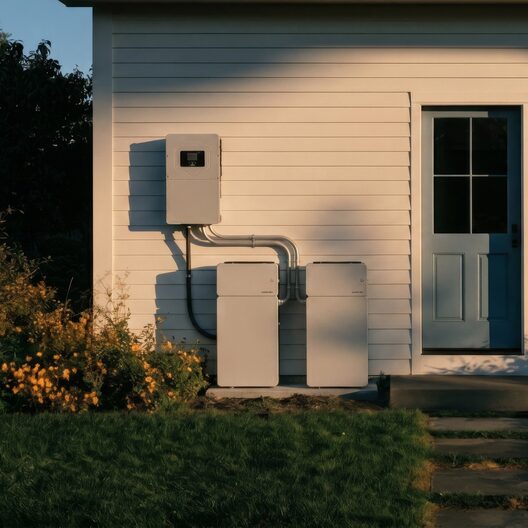
A home battery stores electricity and releases it when needed. When the power goes out, it activates automatically and keeps your essentials running: lights, refrigerator, phone charging. When the power comes back, it recharges and waits for the next outage.
That is the backup function, and it works well. But battery-only systems offer a second benefit worth understanding: peak-rate avoidance.
Most utilities charge more per kilowatt-hour during peak demand hours, typically late afternoon and early evening, when the grid is under the most strain. Off-peak hours, usually overnight and early morning, carry lower rates.
A battery charged during low-rate hours can discharge during high-rate hours, which means you are paying less per kilowatt-hour even though your total electricity consumption is unchanged. In markets where the gap between peak and off-peak rates is significant, this can produce real savings on top of the backup benefit.
What solar changes
What a battery-only system cannot do is reduce the total amount of electricity you buy from the grid. Whether you buy it at peak or off-peak rates, you are still buying all of it. For homeowners who want to cut their overall grid consumption rather than optimize the price they pay for it, that distinction matters, and it is where solar changes the picture.
A solar panel generates electricity. That is the fundamental difference between a battery-only system and a solar-plus-battery system.
When solar panels are part of the picture, your battery is no longer just storing electricity you bought from the grid. It is storing electricity you generated yourself. The cost of that power, once your system is installed, is effectively zero per kilowatt-hour. You do not pay your utility's supply rate on it. You do not pay the transmission and distribution charges on it. You made it; it's yours.
This changes the economics of the battery entirely. A solar-plus-battery system reduces your grid consumption, which is the actual driver of most of what appears on your monthly electricity bill. In Illinois, where supply and delivery rates have risen sharply over the past several years, that reduction is worth real money. In Massachusetts, where the average residential rate is among the highest in the country, the same math applies.
The backup function works exactly as it does with a battery-only system. When the grid goes down, your battery discharges and your home stays on. But on every ordinary day in between, your solar panels are generating electricity your household uses directly, charging the battery with whatever is left over, and cutting into what you owe the utility at the end of the month.
The cost question
How you pay for either system has a significant effect on how the comparison works.
If you are buying with cash or a loan, battery-only is cheaper than battery + solar. A standalone home battery typically runs $10,000 to $15,000 installed. A full solar-plus-battery system costs considerably more, once you add panels, inverters, and the associated installation work. For a homeowner who wants backup protection and is paying out of pocket, battery-only is the more accessible option.
The comparison shifts under a power purchase agreement, or PPA. In a PPA, a provider installs and owns the entire system. The homeowner pays nothing upfront and instead pays a monthly rate for the electricity the system delivers. Maintenance, monitoring, and repairs are covered by the provider for the life of the contract, typically 20 to 25 years.
Under this model, both battery-only and solar-plus-battery can be zero upfront. The meaningful difference is what happens to your monthly electricity bill.
A battery-only PPA gives you backup power at a predictable monthly cost, but your utility bill continues as before. A solar-plus-battery PPA also gives you backup power, and at the same time reduces your grid consumption, which lowers your utility bill.
Over the 20- to 25-year life of a PPA, that monthly bill reduction adds up. Battery-only cannot produce that result. It is not designed to.
When battery-only is the right answer
There are two situations where battery-only makes clear sense.
The first is a roof that cannot support solar. Heavy shade from trees or adjacent buildings, a structural limitation, or an orientation that does not face enough direct sunlight can make solar panels impractical. If solar-plus-battery is not on the table, a battery-only gives you backup protection you would not otherwise have.
The second is a homeowner who wants to pay cash for backup power and does not want the additional complexity of a solar installation. If the bill-savings angle is not the priority and you want a simpler, lower-cost product you can own outright, battery-only is a reasonable fit.
But for many homeowners, neither of those conditions applies.
What Daylight offers
Daylight installs solar panels and a backup battery together, at zero upfront cost, through the PPA model. The battery is included standard in every installation, no monthly adders or additional cost. Maintenance is covered as well.
The result is a system that handles both problems: your home is backed up when the grid goes down, and your bill is lower on every day it does not.
For a homeowner with a workable roof who is weighing backup power, the solar-plus-battery PPA is the stronger offer in almost every scenario. You get everything battery-only provides, plus the monthly savings only solar can deliver, for the same zero upfront cost.
Co-founder / CTO at Daylight. Sunnyside is Daylight’s guide to energy, the grid, and the weather that moves your bill.