Most people's mental image of a solar panel is about 20 years out of date.
They picture something chunky and bluish on a neighbor's roof, a novelty purchase, expensive, probably not worth it for most homes. That picture was arguably accurate in 2005. It is not accurate today.
The residential solar panel has undergone a radical transformation in the past decade. Far from the clunky eyesores that shut down on a cloudy day, today’s panels are a fundamentally different product.
To understand how different, it helps to understand where it started.
The 1950s and 1960s: a tool for outer space
The modern solar cell was born in 1954 at Bell Labs in New Jersey, where researchers developed the first practical silicon photovoltaic cell. It converted about 6% of sunlight into electricity. It was extraordinarily expensive, roughly $300 per watt of capacity in today's terms, which made it useful for exactly one application: powering satellites, where cost was secondary to weight and reliability.
For the next two decades, that was solar's world. The Vanguard 1 satellite launched in 1958 with solar panels aboard. The space program refined the technology, but the technology, quite literally, was not ready for life on earth.
The 1970s: the first glimpse of something bigger
The 1973 oil embargo changed the calculation. With gas lines around the block and electricity prices rising, the federal government poured money into solar research. The cost of solar power fell sharply, from around $100 per watt in the early 1970s to about $20 by the end of the decade.
The first genuine residential solar buildings appeared. In 1979, President Jimmy Carter had solar panels installed on the White House roof. A handful of pioneering homeowners put early systems on their houses. The panels worked, in a manner of speaking. They were mostly thermal systems, heating water rather than generating electricity. Residential photovoltaic systems, the kind that produce power for your lights and appliances, remained a curiosity even for the most committed early adopter.
Efficiency for commercial cells sat around 10 to 12%. A system large enough to power a modest home would have cost the equivalent of $200,000 or more, and the panels themselves were bulky, fragile, and degraded at roughly 1% per year, meaning a 25-year-old installation would be running at three-quarters of its original capacity.
The 1980s and 1990s: a long road for true believers
The 1980s were a step forward and, in some ways, a step back. Federal funding for solar research was cut and President Carter's panels were unceremoniously removed from the White House. Prices kept falling, reaching around $10 per watt by the mid-1980s, but that was still prohibitively expensive for most families.
The dominant solar technology in this era was polycrystalline silicon: the slightly blue, speckled panels that still define many people's mental image of solar. They were cheaper to manufacture than monocrystalline cells but less efficient, typically 13 to 15%. A system still required significant roof space to produce meaningful power, payback periods stretched to 15 or 20 years, and financing options were essentially nonexistent.
The people who put solar on their homes in this era were true believers: willing to pay a premium, comfortable with the uncertainty, and largely on their own when something went wrong.
The 2010s: the decade everything changed
If the previous 40 years were a slow build, the 2010s were the breakthrough.
Module costs fell from roughly $2 per watt in 2010 to under $0.50 per watt by the end of the decade, a 75% drop.
With prices falling, several things happened at once. Manufacturing scaled globally. Monocrystalline panels, which produce more power per square foot, became cost-competitive with polycrystalline. A new cell architecture called PERC (Passivated Emitter and Rear Contact) moved from the lab into commercial production around 2013 to 2015, pushing residential efficiencies past 18%, then 19%, then 20%.
What that meant for a homeowner: a system that previously required 30 or 40 panels to power a home could now do the same job with 18 or 20. On a typical suburban roof, that was the difference between a system that barely fit and one with room to spare.
Panel warranties also matured. Twenty-five-year performance guarantees became standard across reputable manufacturers. Independent testing organizations began publishing reliability scorecards, giving homeowners and installers a way to compare panels on performance rather than just price. The industry was growing up.
Residential installations in the United States grew from roughly 900 megawatts in 2010 to over 7,000 megawatts by 2019. Solar had arrived.
The 2020s: the current generation
The generation of panels going onto roofs today represents the next step past everything the 2010s produced.
The dominant cell technology has shifted again. N-type TOPCon (Tunnel Oxide Passivated Contact) overtook PERC as the most widely installed residential cell technology in 2024, capturing roughly 65% of global production. The practical effect for homeowners: mass-market panels are now routinely achieving 22 to 23.5% efficiency. Compare that to the 13% typical of a 1990s panel. The same roof area that once supported a modest system can now support a genuinely powerful one.
Degradation rates have fallen just as sharply. Modern N-type panels from reputable manufacturers degrade at 0.3 to 0.4% annually, and some premium products are warranted at 0.25% per year. After 25 years, a panel at that rate is still operating at around 93% of its original capacity. Warranties have followed: 30-year performance guarantees are now available from leading manufacturers, which means a panel installed today carries a warranty longer than many home mortgages.
The PVEL (PV Evolution Labs) annual reliability scorecard, the closest thing the industry has to an independent consumer report, released its 2026 findings last month. The headline finding was a paradox: average performance across the industry is at record highs, while test failure rates are also at record highs. What that means is that the best panels have gotten genuinely excellent, while quality disparity between manufacturers has grown. The technology is not uniformly good. Who sources and selects the panels matters more than ever.
What to expect from a modern installation
A homeowner installing solar today with a reputable installer and current-generation panels can reasonably expect the following:
• Panel efficiency between 21% and 23.5%, meaning more power from less roof space than any previous generation. A system sized for an average home now typically fits comfortably on most suburban roofs.
• Annual degradation under 0.5% per year from top-tier manufacturers, with many warrantied at 0.3% or better. A well-installed system is a 30-year asset.
• A 25 to 30-year performance warranty covering both product defects and power output. The panel is warranted to still produce at least 85 to 90% of its original output at the end of that window.
• Output that holds up in real-world conditions. Modern panels perform meaningfully better in diffuse light (overcast days, early morning, late afternoon) than older generations, partly because of improved cell architecture and partly because of better anti-reflective coatings.
None of this was true in 1990. Very little of it was true in 2010.
The residential solar panel has had one of the most significant technological transformations of any home product in recent memory. The question for homeowners is no longer whether the technology works. It does. The question is whether they want to be among the people taking advantage of it.
What Daylight offers
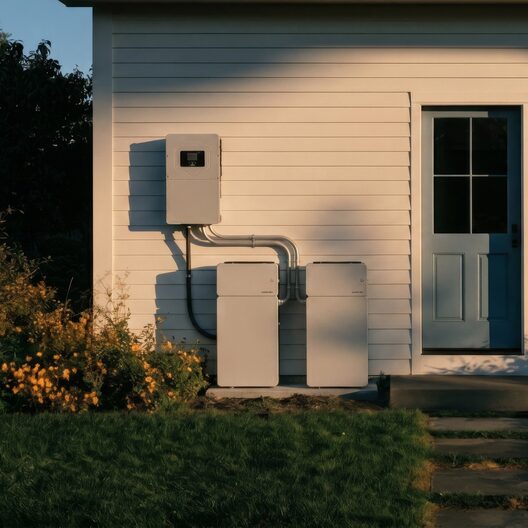
Daylight installs current-generation solar panels alongside a backup battery, at zero upfront cost. The battery is included standard, no monthly adders or additional cost. Homeowners get a locked energy rate and backup power when the grid goes down.
The technology has arrived. The delivery model is finally catching up.
Co-founder / CTO at Daylight. Sunnyside is Daylight’s guide to energy, the grid, and the weather that moves your bill.