Five years ago, almost no one had a home battery. Today, residential battery storage is one of the fastest-growing categories in consumer energy. According to Wood Mackenzie, US residential battery installations jumped 92% in 2025 versus the prior year.
The growth reflects a shift in how homeowners think about electricity. About one in four American households experienced a power outage in the past year, according to Census Bureau data. Average outage duration keeps rising. Electricity rates in many states have climbed sharply. And the grid, as anyone paying attention to the news knows, is under pressure it wasn't built to handle.
The home battery sits at the intersection of those concerns. It provides backup power when the grid fails. It reduces electricity costs when rates are high and you're drawing on stored power instead of paying peak prices. And for homeowners with solar panels, it captures what the roof generates and stores it for when it's actually needed.
The product has also become more accessible. Falling hardware costs and new ownership models, particularly power purchase agreements where a provider installs and owns the system and the homeowner pays a monthly rate, have opened home batteries to a much wider audience.
If you've been curious about what a home battery actually is and how it works, this is where to start.
What is a home battery?
A home battery is a large rechargeable energy storage system, more closely related to a car battery pack than to the AA batteries in your remote.
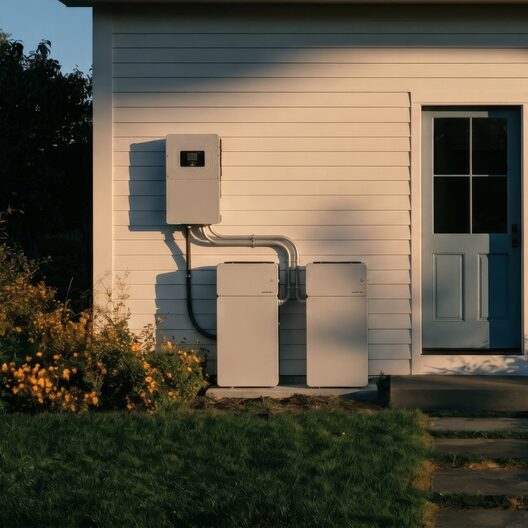
The unit is typically installed in a garage or utility room and connects to your home's electrical panel. Some systems mount to the wall; others stand on the floor. Most residential systems hold between 10 and 20 kilowatt-hours of electricity. A single kilowatt-hour is roughly what it takes to run a standard refrigerator for a day.
The job of the battery is simple: store electricity when you have more than you need, and release it when you don't.
What's inside it
The dominant chemistry in home batteries today is lithium iron phosphate, known by the abbreviation LFP. It's one variety of lithium-ion battery, and in 2025 it accounted for more than 80% of new residential storage installations globally.
Earlier lithium-ion batteries used cobalt in the cathode, which gave them high energy density but also increased the cost and made them more prone to overheating. LFP replaces cobalt with iron and phosphate, a molecular structure that is significantly more stable thermally.
LFP batteries are less likely to run dangerously hot, last longer through more charge and discharge cycles, and have become substantially cheaper as manufacturing has scaled. The trade-off is slightly lower energy density, meaning an LFP battery is a little bulkier than a comparable cobalt-chemistry unit. For residential use, that trade-off is worth making.
How it connects to your home
A battery stores electricity as direct current (DC). Your home runs on alternating current (AC). The device that bridges them is an inverter, which converts power in both directions: DC from the battery into AC for your home, and AC from the grid or solar panels into DC for storage.
When the grid is working normally, the battery sits connected and either charges, discharges to the home, or simply waits, depending on how it's programmed.
When the grid goes down, the system switches over using an automatic transfer switch. The switch senses that grid power is gone and physically disconnects your home from the utility lines, isolating your home as a self-contained island, before connecting your battery's output to your home's panel.
This sequence, called break-before-make, happens in 16 to 50 milliseconds. For reference, the average human blink takes 150 to 400 milliseconds. The result, in practice, is that most appliances don't register a gap at all.
How it charges
A home battery has two charging sources: the utility grid and solar panels.
From the grid, the battery charges like any other rechargeable device, pulling electricity during hours when it makes sense to do so. For most homeowners, that means overnight or early morning, when grid demand is low and electricity tends to be cheaper. The battery stores that power and discharges it during the late afternoon and evening, when grid demand is highest and prices are most elevated. This strategy, called peak shaving, can reduce what you pay per kilowatt-hour even without generating any of your own power, if your utility offers time-of-use pricing.
From solar panels, the battery charges with electricity your roof generates. On a sunny afternoon, panels often produce more power than a household can use at that moment. Without a battery, that surplus goes back to the grid at whatever rate your utility credits you. With a battery, the surplus charges the battery, which you draw on after the sun goes down.
The solar charging relationship is also what extends backup coverage during a grid outage. A battery charged from the grid will run until depleted and then wait. A battery connected to solar will recharge during daylight hours, extending coverage without any action required on your part.
What it can actually power, and for how long
A single home battery unit, typically 10 to 14 kilowatt-hours of usable capacity, can run your essential loads for a meaningful stretch. Essential loads are the things most households actually need during an outage: the refrigerator, lights, phone charging, internet equipment, a CPAP machine, and similar low-draw devices. Running those, a 13.5 kWh system lasts roughly 10 to 18 hours, depending on actual usage.
The calculation changes significantly when you add high-draw appliances. Central air conditioning, electric stoves, and electric water heaters are power-hungry. A single battery running whole-home loads including HVAC will last two to four hours.
There is no single right answer to how long a battery lasts during an outage. It depends entirely on what you're running. A well-configured system covers a household's critical loads through an overnight outage on a single charge, and may cover multiple days when paired with solar.
How long the battery itself lasts
LFP batteries are rated for 3,000 to 5,000 full charge-and-discharge cycles before capacity falls to around 80% of the original rating. Cycled once a day, that works out to eight to 14 years before meaningful degradation. Most residential battery manufacturers warranty their systems for 10 years, and real-world performance tends to track well against those projections.
Degradation is gradual, not sudden. An eight-year-old battery typically still functions well. It just holds somewhat less charge than it did when new. Capacity fades slowly, the way a phone battery does over years of use, but on a much longer timeline.
What this all adds up to for a homeowner
A home battery is a serious piece of home infrastructure.
The technology has matured significantly in the past five years. Chemistry is more stable, cycle life is longer, costs have come down, and systems being installed today are meaningfully more capable than what was available in 2020. If you've been putting off understanding what a battery actually does, this is a reasonable time to get up to speed.
Co-founder / CTO at Daylight. Sunnyside is Daylight’s guide to energy, the grid, and the weather that moves your bill.